


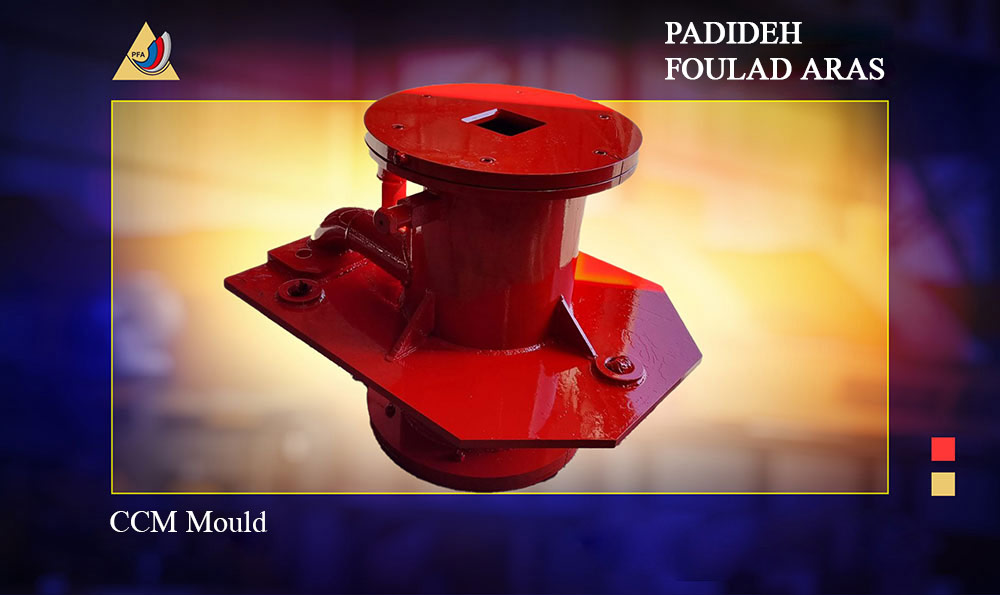
Continuous casting plays a vital role in iron and steel production, with the continuous casting crystallizer recognized as the “heart” of the casting machine. Molten steel solidifies through the cooling process within the crystallizer. To prevent the cast billet from adhering to the copper wall of the crystallizer during solidification—and to avoid cracking or shell leakage—vertical oscillations of the crystallizer ensure smooth billet withdrawal.
The periodic upward and downward vibrations of the continuous casting crystallizer, governed by specific parameters, can alter the relative position between the molten steel surface and the copper wall. This motion applies a forced separation effect on the billet shell and enables the sealing of any shell leakage within the crystallizer.
Simultaneously, during oscillation, the infiltration of protective slag into the copper wall enhances lubrication, prevents bonding between the high-temperature condensate shell and the copper surface, and reduces frictional resistance during billet withdrawal—ultimately improving the surface quality of the cast billet.
The oscillation modes of the continuous casting crystallizer include synchronous vibration (rectangular wave), negative slip vibration (trapezoidal wave), sinusoidal vibration, and non-sinusoidal vibration.
Non-sinusoidal vibration technology, due to its significant impact on improving billet quality and increasing casting speed, is recognized by continuous casting operators both domestically and internationally as one of the key technologies for advancing high-efficiency continuous casting.
During the solidification process, as molten steel is injected into the crystallizer and the shell thickness gradually forms, the crystallizer must exhibit excellent thermal conductivity, cooling capacity, and wear resistance, along with high mechanical strength and ease of handling. Advanced narrow and uniform water gaps, combined with high-speed internal and external water cooling structures, are effectively implemented to prevent localized boiling of the cooling water. As a result, the casting billet not only develops a thicker shell through the crystallizer but also experiences reduced corner cracking and splitting during solidification.